










Most of your facility’s electricity costs aren’t determined by how much energy you use. They’re determined by how much you use in your worst 15 minutes.
A 15-minute spike can set your demand charge for the entire month. A high kW draw, such as a chiller cycling on, a production line ramping, or an HVAC system responding to a cold snap, locks in a charge that applies regardless of how efficiently the facility runs for the rest of the month. NREL research estimates that demand charges account for 30% to 70% of a commercial electricity bill.
Peak shaving with a battery energy storage system (BESS) is the most direct response to the problem. The battery charges during low-demand periods, then discharges to hold metered demand below a target threshold when facility load spikes. The savings appear on the utility bill the following month.
This article covers:
- How demand charges are structured
- How peak shaving battery storage works
- Where commercial battery storage makes financial sense
- Commercial energy storage cost and payback
How demand charges are structured
At a glance, industrial utility bills look straightforward: energy in, cost out.
But buried in that structure is a component that behaves very differently and often accounts for a disproportionate share of the total cost.
Demand charges don’t reflect how much electricity you use over time. They reflect how your facility behaves at its most intensive moment. Specifically, they’re based on your highest level of power draw (kW), typically measured over a 15-minute interval, though some utilities use 30-minute windows during the billing cycle.
This creates a challenge for traditional efficiency strategies. You can reduce overall energy consumption and still see only a limited cost impact because a single brief spike can set your demand charge for the entire month. In effect, a 15-minute surge is priced the same whether it happens once or repeatedly.
This isn’t just a concern in high-cost energy markets. NREL research shows that some of the highest demand charge rates occur in states not typically associated with expensive electricity, like Colorado, Nebraska, Arizona, and Georgia, thereby expanding the risk well beyond coastal markets.
How peak shaving battery storage works
Peak shaving with battery storage is straightforward in concept: charge when demand is low and discharge during peak periods to keep your metered demand below a set threshold. Instead of a spike hitting the grid, the battery supplies part of the load, flattening the peak that drives demand charges.
It’s often grouped with load shifting or time-of-use (TOU) arbitrage, but the objective is different.
- Load shifting moves when energy is used
- TOU arbitrage optimizes for energy price
- Peak shaving reduces the highest point of demand
In other words, shifting moves the peak. Peak shaving lowers it. The same BESS hardware can execute all three strategies; what changes is how the EMS is configured and what outcome it’s optimizing for.
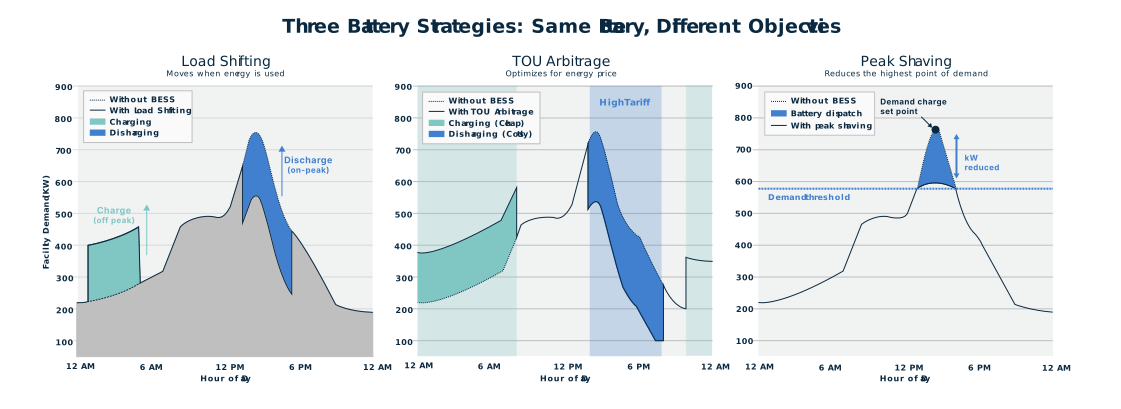
The same BESS hardware can execute all three strategies. Peak shaving is optimized to reduce the highest kW reading in each billing period.
This is where a BESS stands apart. Efficiency measures and solar can reduce overall consumption, but they don’t reliably address short, high-intensity spikes. A BESS is dispatchable. It can respond in real time or against a forecast to manage demand precisely when it matters.
That said, a BESS is only as effective as the software managing it. Its corresponding energy management system (EMS) forecasts facility demand and controls battery charging and discharging. If the EMS gets the timing right, the battery intercepts the spike before the meter registers it. If it discharges too early, the battery may be depleted by the time the actual peak arrives. Forecasting accuracy is what separates a system that consistently hits its savings target from one that doesn’t.
What the savings look like
Below is a worked example that explains peak-shaving economics. Consider a manufacturing facility with the following profile:
- Peak demand: 1,200 kW (15-minute interval)
- Demand charge rate: $15/kW
- Monthly demand charge before peak shaving: $18,000
- Targeted peak reduction with BESS: 30%
- Reduced metered peak: 840 kW
- New monthly demand charge: $12,600
- Monthly savings: $5,400
- Annual savings: $64,800
The savings appear as a single line item on the utility bill (the demand charge) and are directly verifiable against the prior billing cycle. Unlike efficiency upgrades, which require modeling assumptions to estimate impact, peak shaving yields a number that the customer can read off the bill each month.
Where commercial energy storage for peak shaving makes the most sense
The facilities that see the strongest returns share a common profile: demand spikes that are sharp, brief, and recurring. Manufacturing plants with large motor starts, data centers managing cooling load spikes, cold storage facilities, buildings with heavy HVAC demand, and sites running DC fast EV charging all fit that description. The peak-to-average ratio is high, the timing is reasonably predictable, and the underlying processes are inflexible enough that load shifting isn’t a realistic alternative.
Three load characteristics predict good economics:
- High peak-to-average ratio: The wider the gap between peak and average demand, the more a BESS has to work with and the larger the potential demand charge reduction.
- Predictable spike timing: Consistent timing gives the EMS enough lead time to position the battery before the meter registers the peak.
- Inflexible processes: When operations can’t be rescheduled around utility pricing windows, peak shaving is often the only lever available.
Not every site is a good fit. Facilities with flat, sustained load profiles don’t produce the sharp peaks that a battery can shave effectively. Sites in territories with low demand charge rates may not generate enough savings to justify the capital outlay. And facilities where peak timing is genuinely unpredictable create forecasting challenges that reduce the reliability with which the EMS can deploy the battery before the meter registers the spike.
Commercial energy storage cost and payback
Battery storage system costs have declined significantly over the past decade and continue to fall as lithium-ion manufacturing scales. A complete system includes the battery pack, power conversion (inverter), balance of system, and installation. Soft costs such as engineering, permitting, and commissioning, add to the total and vary by site complexity.
At Redaptive, we typically see payback periods ranging from five to nine years, depending on local demand charge rates, tariff structure, and available incentives. That range compresses when a facility stacks additional value streams on top of peak shaving.
The same BESS that manages demand charges can also perform TOU arbitrage, support solar self-consumption, provide backup power resilience, and participate in utility demand response programs. Peak shaving is typically the economic foundation of that stack, but it rarely has to carry the entire return on its own.
For many finance leaders, however, the more relevant question isn’t the payback period; it’s whether the investment needs to clear an internal CapEx hurdle.
Redaptive’s Energy-as-a-Service has no upfront capital requirement. Our team finances, designs, and installs the system, and customers pay based on measured performance or the share of verified savings delivered.
The financial conversation shifts from managing a capital outlay to evaluating a monthly cost against a monthly saving, which is a simpler calculation that doesn’t compete with other capital priorities or sit on the balance sheet. And because payments are tied to measured outcomes rather than installed capacity, the forecasting and performance risk shift to Redaptive. If savings fall short, the obligation to close the gap rests with Redaptive rather than the customer.
Take control of your demand charges
For finance and facility leaders managing facilities with high or unpredictable demand charges, the question isn’t whether peak shaving works. It’s whether the path to implementation is worth the effort. Under an EaaS model, the capital barrier and the added risk that typically complicate that decision are removed from the equation. The result is a predictable monthly cost offset directly against a measurable monthly saving, no capital approval required, no performance risk on your books.
If you want to understand what peak shaving could mean for your facility’s utility bill, contact us today to speak with a battery storage expert.