








According to the Bureau of Economic Analysis, the average age of U.S. manufacturing facilities is almost 26 years. The core infrastructure inside, including lighting, HVAC, controls, and building systems, is often just as old, driving up energy consumption and maintenance costs year over year.
But when infrastructure improvements compete directly with other business investments for scarce CapEx, they often stall and remain in the backlog, even as the cost of waiting grows.
Redaptive’s CFO Playbook makes the case that this tradeoff is no longer necessary. Here’s a brief overview of what the playbook covers:
- Facility upgrades are now a capital-efficiency strategy through a new model that funds modernization off-balance-sheet without tapping existing credit lines.
- Finance leaders can apply this model to protect liquidity, accelerate modernization timelines, and capture verified financial and ESG outcomes.
- How Iron Mountain modernized 428 facilities and generated more than $95 million in lifetime savings without deploying CapEx.
Why modernization stalls: Capital constraints and operational friction
Traditionally, facility modernization has been driven by CapEx. If upgrades fit within the budget, they move forward. But more often, they’re deferred until the next budget cycle, as industrial organizations allocate capital to new production equipment, automation tools, and other revenue-generating assets.
Many modernization models, such as single-system performance contracts and equipment leasing agreements, have tried to fill the gap but have been constrained by operational friction. Narrow service contracts fail to deliver portfolio-wide modernization or unified financial outcomes, and project-by-project execution increases costs, slows timelines, and diverts internal resources from other business priorities.
The result: capital stays locked in aging assets, OpEx rises, and modernization falls years behind strategy.
The new CFO solution: Energy infrastructure modernization
The CFO Playbook introduces a model that funds facility upgrades off-balance-sheet with no upfront CapEx or draw on existing credit lines.
Structured as an Energy-as-a-Service (EaaS) agreement, the model positions modernization as a capital efficiency strategy rather than an operations project funded from the capital budget. The organization preserves its borrowing capacity and redirects freed capital toward growth investments while a single partner manages design, procurement, installation, and ongoing performance across the entire portfolio.
Energy infrastructure modernization rests on three pillars:
- Tailored capital. Off-balance-sheet structures that preserve credit ratios and financial flexibility.
- Turnkey execution. One partner handles multi-site, multi-system deployment in standardized waves, reducing the operational burden on internal teams.
- Measured outcomes. Real-time verification of energy savings and emissions reductions, with board-ready reporting aligned to governance, audit, and investor requirements.
Financial outcomes for CFOs
The value equation for energy infrastructure modernization maps directly to financial metrics: liquidity, capital efficiency, OpEx reduction, and risk mitigation.
- Balance sheet protection. No CapEx is required, leverage ratios remain intact, and credit availability is preserved for higher-return investments.
- Accelerated modernization. Portfolio-wide deployment (i.e., thousands of assets under a single approval) significantly compresses timelines compared to traditional site-by-site methods. That velocity translates directly into faster OpEx reduction and earlier ESG reporting impact.
- Verified, auditable outcomes. Real-time data on cost savings, energy consumption, and emissions provides transparent reporting for boards, auditors, and investors. Leaders get measured performance instead of estimated projections.
- Operational risk reduction. Newer assets reduce equipment downtime, lower compliance exposure, and improve reliability through predictive maintenance and consistent standards across sites.
Energy infrastructure modernization in action
Iron Mountain’s modernization program illustrates the scale of what is achievable. Through Redaptive’s model, the company modernized 428 facilities across five countries, generating more than $95 million in energy savings over the life of the program.
And none of it required CapEx or impacted Iron Mountain’s leverage.
Read how we designed, funded, and delivered Iron Mountain’s modernization program here.
Getting started: From playbook to roadmap
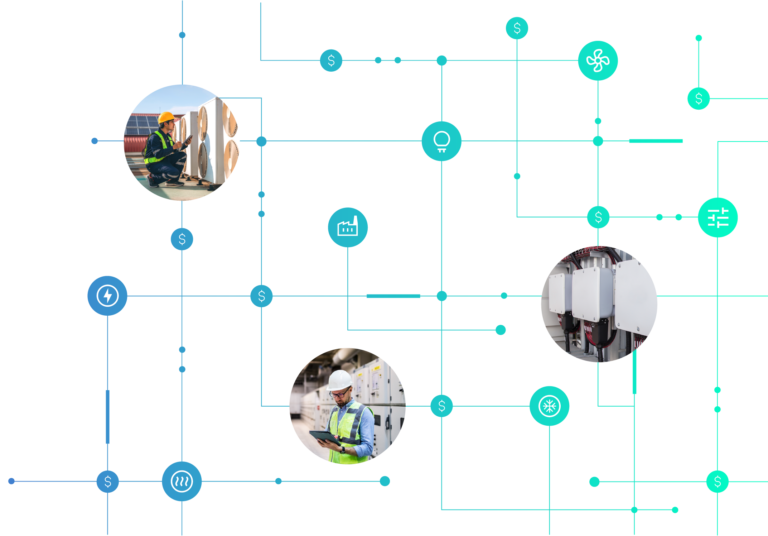
Organizations that approach energy infrastructure modernization as a cross-functional strategy, not just a procurement decision, tend to see faster adoption and broader impact. The CFO Playbook outlines a five-step process for evaluating and implementing the model, starting with identifying portfolio-wide infrastructure needs across lighting, HVAC, controls, refrigeration, metering, and building systems.
From there, the playbook walks through stakeholder alignment across finance, real estate, operations, sustainability, and procurement. It then lays out a framework for comparing CapEx-driven approaches against outcome-based models, quantifying both financial and ESG value, and selecting the right partner for portfolio-wide modernization.
Finance leaders use the playbook as a starting point to frame the opportunity and build the case across stakeholders.
Start building your modernization roadmap
Download The CFO Playbook and map out a modernization roadmap that protects liquidity, reduces OpEx, and keeps capital free for growth investments.
Ready to see how this model benefits your portfolio?